The ABC of lawn aeration

In spring, when the soil has dried sufficiently, the lawn should be aerated. What does lawn aeration mean? Lawn aeration is the creation of openings/cuts in the soil so that air, water and nutrients can reach the grass roots more easily.
What does grass need?
Nutrients: organic material and fertilisers
CO2: an important component for carrying out photosynthesis
Moisture: an important component for the transport of nutrients
Light: necessary for carrying out photosynthesis
If the lawn surface is compacted and not aerated, the nutrients do not reach the grass roots. Aeration is also necessary to suppress the activity of moss. In shadier places, moss tends to smother and crowd out the grass with its activity.
It would be sensible to aerate the lawn in late spring, when it is at least 10 degrees outside, and a second time, for example, towards autumn – then the lawn has time to recover for winter and goes into its winter rest even stronger. Shady and mossy spots can also be treated repeatedly during the summer, but first the grass should be mown to about 2-3 cm high. Aeration should certainly not be undertaken during a heatwave, as there is then a risk of the lawn drying out.
Firstly, you should not confuse soil aeration, which is done with an aerator, and moss removal, which is done with tines. During moss removal with tines the grass also gets a little air, but this is not lawn aeration. The tined working tool removes the existing moss very effectively, but has no long-term effect, since it does not cut openings in the soil through which nutrients and water could reach to revive the grass.
Proper aeration is done with metal blades that cut or perforate the soil so that aeration openings are created. Aerators, i.e. soil aerators, have various solutions and working tools – we introduce them in more detail based on the equipment we have for rent and for sale.
Stiga SVP40B, Alpina SC40G


This is a powerful petrol-engine soil aerator. The dried grass and moss is collected either into a 50-litre bag or, when used without a bag, is left behind and then has to be raked up afterwards. The machine's working width is 40 cm and it is equipped with 32 alternating cutting blades for aerating the soil. Weighs 37kg. This aerator has a flail-blade working tool:

This machine is then basically a combined tool of a moss rake and a lawn aerator, since the flail blades act as a dethatcher and at the same time cut aeration openings in the soil. When using the machine you should bear in mind that it is not a tiller and the openings created in the soil should be about half a cm deep. Correct use is then as follows: choose the right working depth according to the degree of blade wear, start the blades and move straight from one end of the area to the other. At the end of each straight run, switch off the blades and only then change direction. Otherwise, firstly a tiller effect occurs at the moment of turning, and secondly the blades wear and bend excessively and can also break off. For a better result, you can first go over the area one way and then make “stripes” the other way.
We also have the Alpina aerator for rent at €35 per day/max 3h of work, every additional hour started €10.
Fixed-blade aerator Viking LB 540


The Viking lawn aerator has a powerful easy-start Kohler engine, a 38cm working width with 6 different heights. It is very easy to manoeuvre and weighs only 33kg, since the housing is made of extra-strong plastic. In appearance it is like a lawn mower, but hidden under the housing is a cutting tool with seven fixed blades:

The fixed blades ensure that proper cuts for aeration openings are created even in harder soil. With this machine you can then aerate the soil, and part of the moss is also removed during aeration, and in the longer term there will be less moss, since moss does not like an aerated surface. With this machine, moving in a straight line and raising the blades before turning is also very important. There are 6 different working-height levels, and according to the wear of the blades you should choose one that creates cuts of a few millimetres deep in the soil. It is important to change the working height only when the blades are in the raised position! All the thatch and moss that is created can either be collected with the 50-litre collector supplied or raked up with a wide leaf rake (Fiskars has XL leaf rake, which is a very good aid for this).
We have the Viking LB 540 aerator for rent: €30 per day/max 3h of work, every additional hour started €10.
A grass and leaf collector for the trailer hitch helps with collecting up
If the area is very large, we also have for rent a brush grass collector that mounts onto a hitch behind a lawn tractor or ATV:

It has a working width of 107cm and a collection-bag capacity of 370 l. The rental price is 30 euros per day. We sell several different leaf collectors – you will find them under lawn-tractor accessories here.
Mains-powered lawn aerators
In addition, we also sell electric aerator-dethatchers with interchangeable working tools.


One working tool is a tined dethatcher and the other is a metal-bladed aerator. They both cost 189 euros and, if a power connection is available, they do their job successfully. Click on the picture to see more detailed product information.
NEW – the hole-making soil aerator Billy Goat

But if you want to give your lawn a real gift, we have, as a new product, the BILLY GOAT PL1802V aerator for rent, whose operating mode differs from all the other models mentioned above. Namely, this machine has a working tool with metal tubes, driven round by a piston-like working tool:

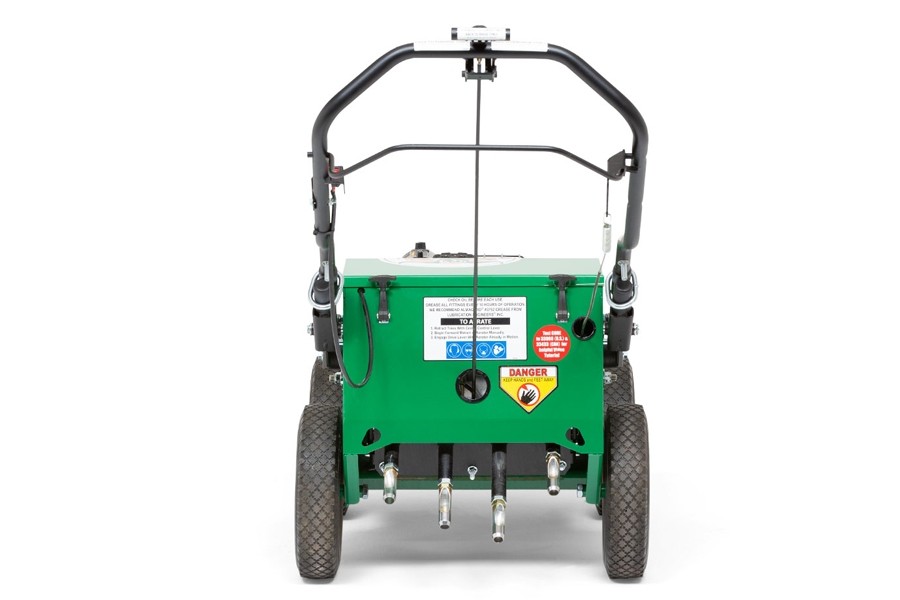
These tubes take small clumps of soil out of the ground:

It would be good to fill these holes with sand – after aeration it is actually always recommended to spread sand on the surface – then drainage is created and water and nutrients reach the grass roots better. This is then not, in the classic sense, the removal of moss and dead grass, but real lawn aeration. So this product does not replace the products above but, in the long term, gives an ideal lawn surface:

In the picture before, you can see how, because of the layer of mown thatch and the hard soil, the grass roots are very weak. After working with the Billy Goat aerator, pockets are created through which water, oxygen and nutrients reach deep into the ground. After about 8-10 weeks the grass roots are much better developed and the grass becomes denser.
A short introductory video of how this machine works:
The video also shows that the soil should first be pre-treated with an aerator or a tined machine and cleaned of old thatch and moss. In the video all the old material is collected up with the Billy Goat vacuum we also have for rent (€50 per day). The vacuum has a 151l collection bag made of durable material, which takes only a few seconds to remove and put back. Thanks to the adjustable suction opening, this machine can be used both on harder ground and on grass, while ensuring an effective result. And the final stage is then aerating the soil with the Billy Goat aerator, which we have for rent at €60 per day/max 3h of work, additional hour started €20.
When and where might overseeding of the lawn be needed?
• For damaged areas, to fill in the empty spots.
• When establishing new lawns.
• After removing thatch and moss, to prevent the emergence of weeds and moss.
In a word – if your lawn looks like this:

But you want one like this:
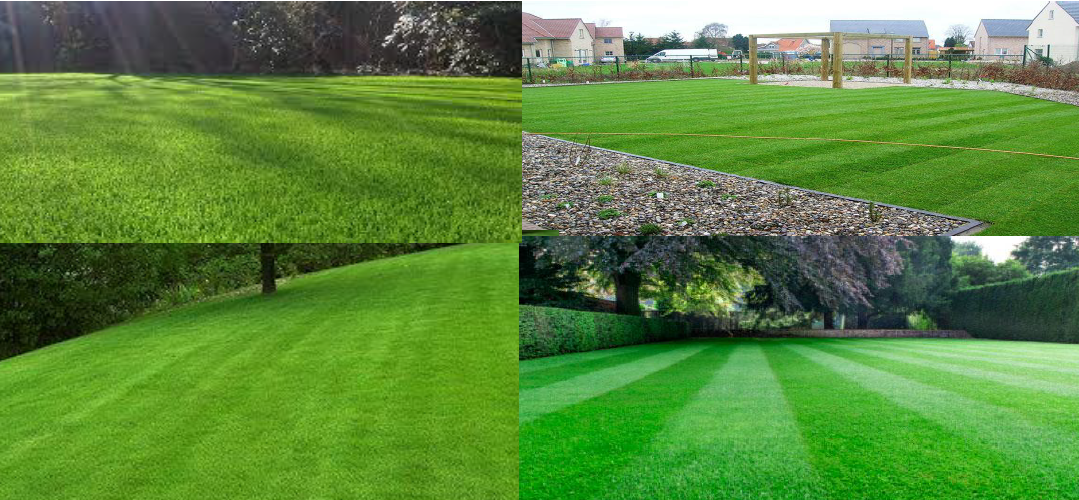
Then you need to take care of the lawn. After aeration, sand the surface, apply fertiliser, and if there are damaged areas or areas without proper grass, put lawn renovation mix there.
Article author: Liina Virumäe
Copying the article or parts of it without the author's written consent is not permitted.
Sources used:
- Catalogue: A well-kept lawn thanks to Viking.
- PowerPoint presentation “Lawn care” Puhastusimport OÜ