Choosing a pressure washer: how many bar do you really need for the job and why water flow is just as important
A frequently asked question is: how many bars should a pressure washer have. Pressure is the figure most washer manufacturers advertise the most. Unfortunately, watching only that is also the quickest way to buy a washer that will not do the job you need. Getting things clean comes from two figures working together, and the second of them often goes unnoticed at the moment of purchase.
Pressure knocks the dirt loose, water flow washes it away
Water pressure, measured in bars, shows how hard the water jet hits the surface. It determines whether the top layer of a mossy stone comes loose at all. Water flow, measured in litres per hour, shows how much water passes through the machine. It determines how quickly the loosened dirt is washed off the surface and how large an area you can cover in one working cycle. High pressure combined with a low water flow means that cleaning a single paving slab, for example, takes a long time.
The difference is noticeable in practice. STIGA HPS 110 delivers 110 bar and 390 litres per hour, STIHL RE 80 120 bar and 430 litres, STIHL RE 100 PLUS CONTROL 150 bar and 450 litres. At the other end of the scale is the STIHL RE 150 PLUS with 180 bar and 610 litres per hour. It is this second number, not the bar figure, that is the reason a bigger machine gets a driveway clean much faster.
The difference shows most clearly with cordless pressure washers. STIHL REA 100 PLUS PRO delivers the same 150 bar peak pressure as the mains-powered RE 100 PLUS CONTROL, but 300 litres of water pass through per hour instead of 450. The machine washes just as hard but covers a smaller area in the same time. The same logic applies on the EGO side: EGO HPW2000E runs at 135 bar and delivers 6.5 litres per minute, or roughly 390 litres per hour.
How much pressure you need for what
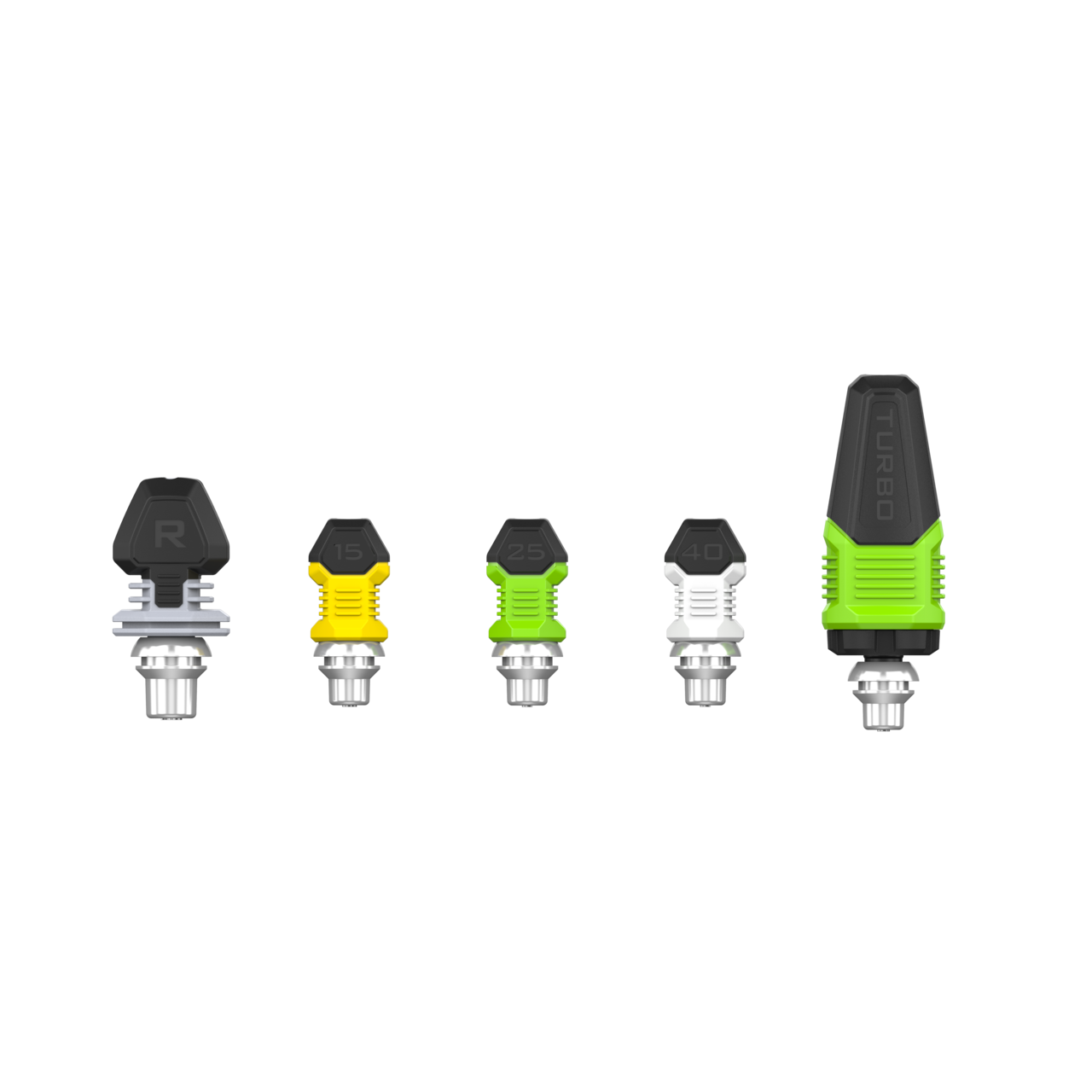
A car, garden furniture, a bicycle and a lawn tractor body come clean at around a hundred bar. Here it is better to rely on a wide nozzle, detergent and patience rather than pressure. Keep the nozzle about thirty centimetres from the surface and do not aim the jet directly at paint damage, tyre valves or door seals.
A wooden deck calls for a calm approach. Reduce the pressure, use a wide-angle nozzle and a greater working distance, and move along the boards, not across them. Too strong a jet tears up the soft top layer of the wood and leaves streaks that stay visible for the whole of the next season.
Stone paving, concrete and the lower part of a building are the surfaces where a more powerful machine really pays off. Moss and green algae need far more pressure than car washing, and a rotary nozzle speeds up the work. On a large area it makes more sense to use a surface cleaner, because the result stays even and spray does not fly across the whole yard. Chemistry often works better than pressure on moss and algae residue, which is why on stone surfaces it is worth using a separate cleaning agent and letting it work before washing.
Where the water comes from and where the power comes from
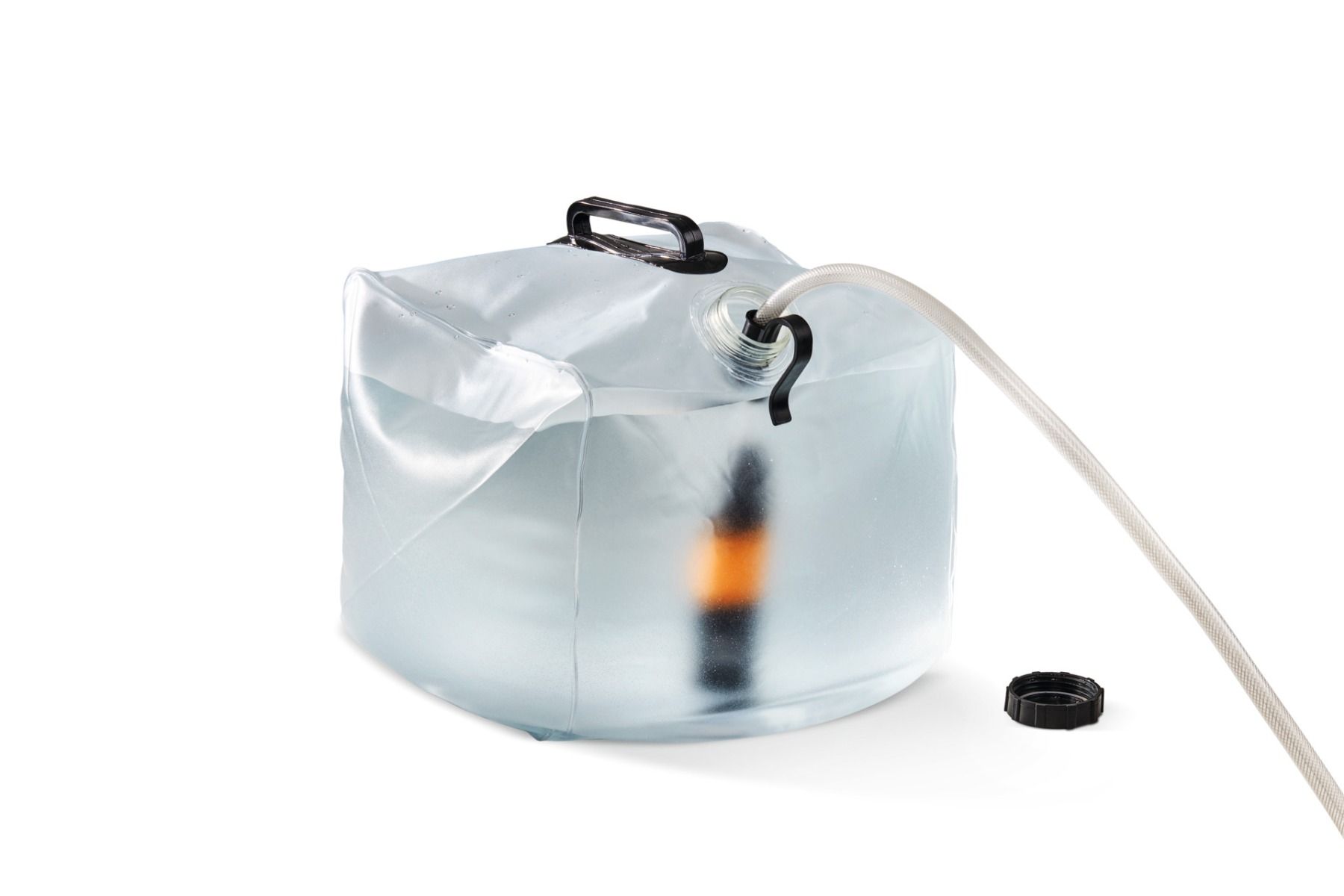
STIHL pressure washers can also be used without mains water pressure, meaning water can be drawn from a rainwater tank, a barrel or a pond. For this you need a suction set, which includes a sturdy-walled suction hose and a foot valve with a filter. If the water comes from a well or a natural water source, be sure to add a water filter, because sand and mud particles quickly wear out the pump, and that failure is not covered under warranty.
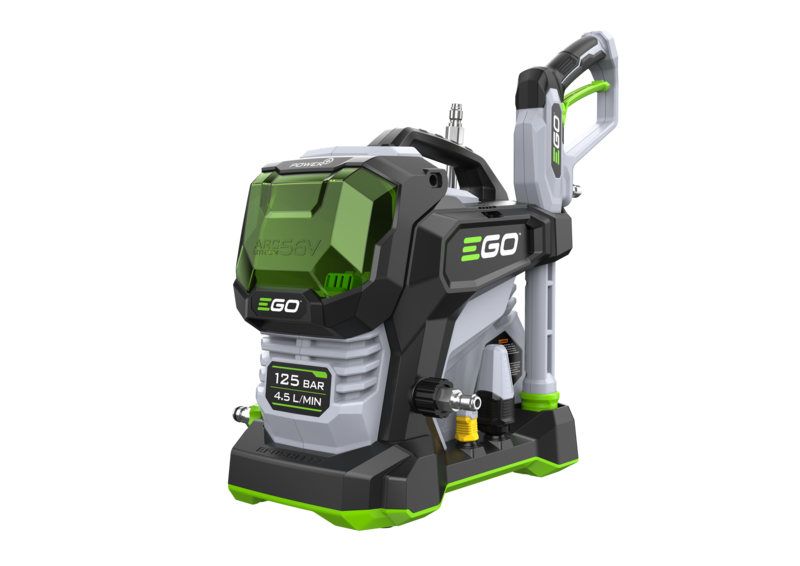
A cordless pressure washer adds independence from mains power. STIHL RCA 20 AS weighs one and a half kilos and delivers 24 bar. That is enough for a bicycle, muddy boots and garden furniture, but not for mossy paving. REA 60 PLUS Compact runs at 100 bar, peaks at 130 bar, and the water flow reaches 270 litres per hour, which is enough for ordinary household washing jobs. If you already have EGO 56 V garden tools in your yard, the EGO HPW1800E with its 125 bar is a logical next step, because it uses the same battery as, for example, your mower and leaf blower, and the machine can be connected to a garden hose as well as the suction hose supplied.
With a mains-powered machine, check two small details. The power cable is usually about five metres long, so allow for the need for an extension lead in advance. The more powerful the machine, the heavier it is: the RE 150 PLUS weighs 31 kilos, which is why wheels and a telescopic handle are not a luxury but the thing that decides whether the machine is brought out of the garage at all. Also keep an eye on weather forecast, because although a pressure washer and water are inseparable, as a rule power tools must not be used in the rain.
The hose decides whether the machine gets used
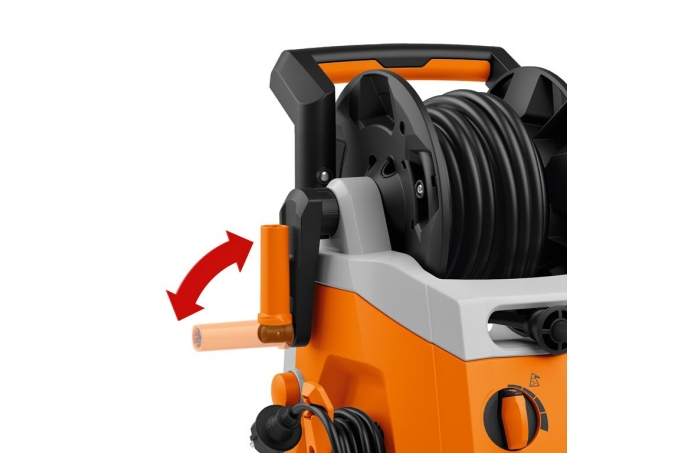
The length of the high-pressure hose affects washing more than it seems at the moment of purchase. With a five-metre hose the washer follows you around the whole time and tends to tip over; with nine or twelve metres it stays put and only the gun moves with you. On the RE 80 and HPS 110 the hose is five metres, the RE 130 PLUS I has nine and the STIGA HPS 650 RG has twelve metres. A hose reel keeps the hose from tangling.
The RE 100 PLUS CONTROL lets you adjust the pressure directly from the spray gun without walking back to the machine. When switching frequently from one surface type to another, this is a very convenient extra feature.
What you must not do with a pressure washer
A robotic mower and its charging station are not washed with a pressure washer, and as a rule not even with a garden hose, because pressurised water finds its way to the electronics and that damage is not covered by the warranty. The exception is the EGO AURA - see the owner's manual for detailed guidance or ask our sales specialist. Batteries, chargers and battery compartments call for the same caution. The body of a lawn mower or lawn tractor can be washed carefully; the engine, electrical parts and bearings must not be.
On a building, do not pressure-wash mortar joints, window seals or the underside of the roof. Water gets into these places easily but is far less willing to come back out. Fresh paint, thermally modified wood and soft wood cope badly with a strong jet aimed at close range, as do car parts such as parking sensors. Most importantly: never point the jet at a person or an animal, not even as a joke. A jet at a hundred bar can easily cause injuries.
For the sake of the machine's longevity, do not let the pump run dry and do not keep the gun closed for long periods while the motor is running. If you take a longer break, switch the machine off.
Which washer to choose
If washing jobs are rare and mains power or tap water is not always at hand, the RCA 20 AS set or the REA 60 PLUS Compact is a good fit. For an ordinary household where the car and the deck get washed a couple of times a season, the RE 80, STIGA HPS 110 or HPS 235 R. If your yard has stone paths and a large deck and the cars get washed often, it is worth looking towards the RE 100 PLUS CONTROL, RE 130 PLUS I or STIGA HPS 345 R . For a farm, a machine fleet and large surfaces, the right choice is the RE 150 PLUS or HPS 550 R and the HPS 650 RG. For those who prefer cordless tools, the REA 100 PLUS PRO and EGO HPW2000E offers the flexibility of cordless working - just allow for the lower water flow and plan battery charging into the job.
Before the cold arrives
The most common winter failure of a pressure washer is simple and entirely avoidable. Water left in the pump freezes, expands and cracks the pump head. At the end of the season, drain the water from the machine, hose and spray gun, and store the washer in a room where the temperature does not drop below zero. Damage caused by freezing is not covered by the warranty.
In summary
Choose the pressure based on the surfaces you wash, the water flow based on how large those surfaces are, and the hose length based on how far from the tap you need to reach. When these three are right, the washing itself becomes a pleasant job.
You will find the full range in the pressure washer category , and nozzles, brushes and cleaning agents under accessories. If you are unsure which model is right for your yard, come and visit us in Tartu at Aardla 25, write to saemeister@saemeister.ee or call +372 7 303 480. Cleaning a robot mower is covered in more detail summer robotic mower maintenance article.