Spring is here, the grass is starting to grow and you head to the garage to get the mower running. You pull the starter cord — nothing happens.
You're not alone. Spring starting trouble is one of the most common reasons for taking equipment in for service worldwide. The good news: in most cases, the cause is one and the same thing, which can be prevented in just 10 minutes back in the autumn.
Reason no. 1: Old fuel in the carburettor
This is by far the most common reason why a mower won't start in spring.
Petrol doesn't keep well. Within just 30 days, the lighter hydrocarbons in the fuel start to evaporate and the fuel begins to turn thick and sticky — it essentially turns into varnish. When this “varnish” gets into the carburettor, it clogs the small jets and the needle valve sticks. The result: the engine can't get fuel and won't start.
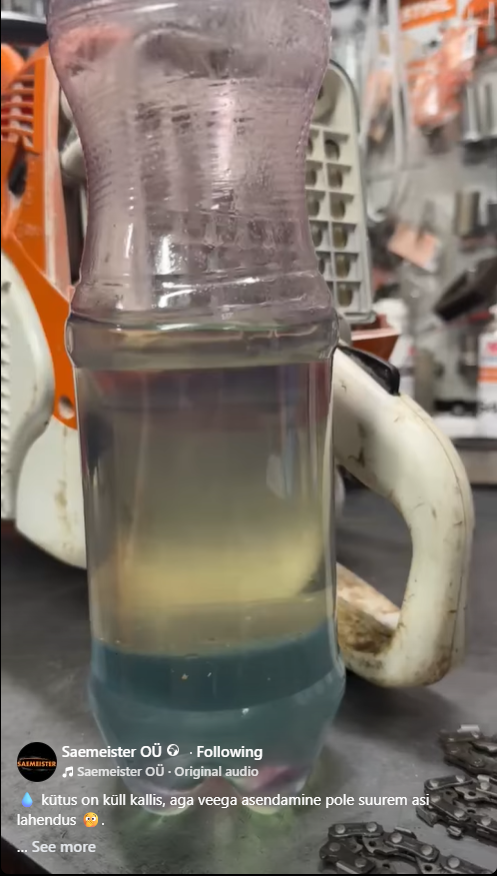
How can you tell the problem is old fuel? Empty the tank and see what comes out. Fresh petrol is clear or pale yellow. Old fuel is brownish and may smell like varnish.
What to do? Empty the tank completely. If there is also old fuel in the carburettor, spray carburettor cleaner — sold at any car parts shop — into the carburettor opening and let it work for 5–10 minutes. Then fill with fresh fuel and try again.
Saemeister tip: If you have a petrol mower, buy fuel in smaller quantities and use it up within 2–4 weeks. If possible, use 98 octane petrol in garden equipment. Even better, use special 4-stroke engine fuel. It's available at any good garden equipment shop, including ours.
The 95-octane petrol sold in Estonia contains 10% ethanol. Ethanol is hygroscopic — meaning it draws moisture from the air. In a mower standing idle over winter, a layer of water and alcohol gradually forms at the bottom of the tank, which:
corrodes metal fuel tanks
damages rubber seals
disrupts fuel combustion so that the engine won't start
Solution: Use a fuel stabiliser (e.g. STA-BIL, Seafoam) every time you put the mower into storage for an extended period. Add the stabiliser to fresh fuel, fill the tank to ~95% (to leave no room for condensation), and let the engine run for 5 minutes so the additive works its way through the entire fuel system.
Alternative: ethanol-free fuel (available at some petrol stations), which keeps significantly longer and doesn't attract moisture.
Reason no. 3: Dirty or worn spark plug
The spark plug generates a spark that ignites the fuel. If soot has built up on the plug, the electrode is worn, or the gap is incorrect, an adequate spark isn't produced and the engine refuses to start.
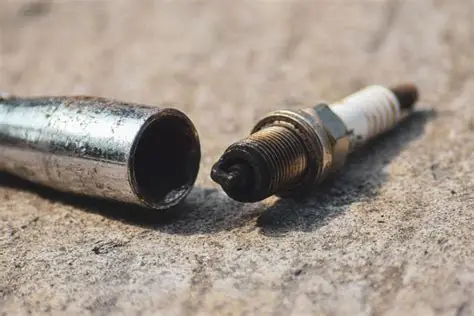
How to check? Remove the spark plug (usually at the front of the mower, directly on the engine). Look at the electrode — it should be greyish and clean. A black, sooty or wet plug is a sign of a fault.
What to do? Clean it with spirit and a brush, or buy a new plug. A spark plug costs €3–8 and replacing it takes 5 minutes. Experts recommend replacing the plug every season — it's one of the cheapest preventive maintenance jobs you can do.
Saemeister tip: Always keep a spare plug in the garage. When buying one, check that the plug matches your engine model — the wrong plug may not work.
Reason no. 4: Clogged air filter
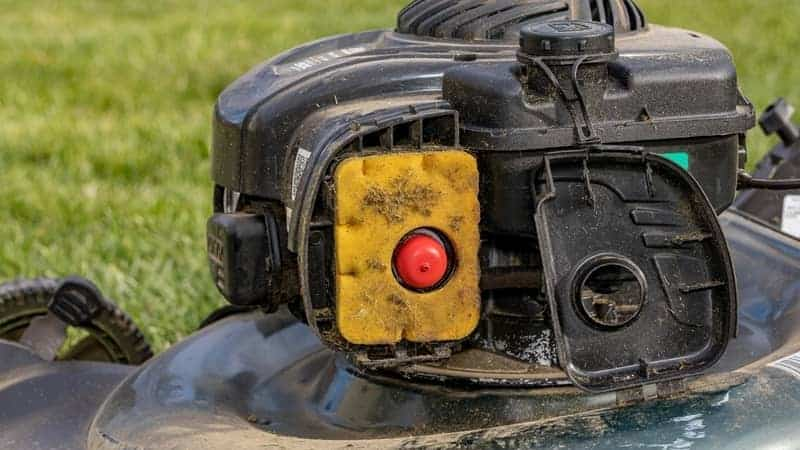
The air filter protects the carburettor and engine from grass, dust and dirt. The filter should be checked every 25 hours of operation.
If the air filter is clogged, the engine doesn't get enough air. The fuel-to-air ratio goes off balance, the engine surges, fails to start, or stalls immediately after starting.
What to do?
Paper filters: hold up to the light — if it's dirty, replace it.
Foam filters: wash with warm water, let dry, and lightly oil before refitting.
Price: €5–15, replacement takes 3 minutes.
Reason no. 5: Mowers with electric start — uncharged battery
Mowers and lawn tractors with electric start usually have a 12V lead-acid battery. Battery life is 3–5 years, but sitting flat over winter shortens this considerably. If the mower makes a “clicking” sound but doesn't start, the battery is probably flat or dead.
Solution:
Charge the battery with a car battery charger (2–10A charging current, slow charging is better).
Check with a multimeter: a fully charged battery reads ~12.6V. Below 12V means the battery is almost empty; below 11.5V means the battery is probably dead.
For winter storage, it's a good idea to use a maintenance charger, which keeps the battery at an optimal level without overcharging it.
Reason no. 6: Starter cord is hard to pull
If the starter cord is hard to pull or doesn't retract at all, grass clippings have probably built up underneath the mower, preventing the blade from turning. This happens especially when wet grass was mown the previous season and the mower wasn't properly cleaned before being put into storage.
What to do? Wind the starter cord back in by hand, switch off the engine and disconnect the spark plug lead (for safety). Tip the front of the mower up and scrape out the grass clippings from underneath with a scraper. Return the mower to level ground before starting it.
Prevention: what to do in autumn for a worry-free spring
The cheapest mower maintenance is proper winter storage in autumn. Here are 5 steps that will save you a lot of headaches in spring:
Empty the tank OR use special fuel + fill the tank and let the engine run for 5 minutes.
Change the engine oil — old, dirty oil contains acids that corrode the engine over winter.
Clean the spark plug or replace it with a new one.
Clean or replace the air filter.
Clean all grass clippings from under the deck — damp grass material rots over winter and promotes rust.
Spring checklist
Before the first mow in spring, do a quick check:
Empty old fuel, fill with fresh
Check the spark plug — clean or replace
Check the air filter — clean or replace
Check the engine oil level and colour
Clean grass clippings from under the deck
(Electric start) Check the battery charge
If, despite everything, your mower is still being temperamental, it probably needs a more thorough carburettor clean or a bit of servicing. We can help with that at the Saemeister service department — bring your mower to us and we'll get it running!
To provide the best experience, we use technologies like cookies to store and/or access device information. Consenting to these technologies will allow us to process data such as browsing behaviour or unique IDs on this site. Not consenting or withdrawing consent may adversely affect certain features and functions.
Functionality
Always active
The technical storage or access is strictly necessary for the legitimate purpose of enabling the use of a specific service explicitly requested by the subscriber or user, or for the sole purpose of carrying out the transmission of a communication over an electronic communications network.
Preferences
The technical storage or access is necessary for the legitimate purpose of storing preferences that are not requested by the subscriber or user.
Statistics
The technical storage or access that is used exclusively for statistical purposes.The technical storage or access that is used exclusively for anonymous statistical purposes. Without a subpoena, voluntary compliance on the part of your Internet Service Provider, or additional records from a third party, information stored or retrieved for this purpose alone cannot usually be used to identify you.
Marketing
The technical storage or access is required to create user profiles to send advertising, or to track the user on a website or across several websites for similar marketing purposes.