How to choose a lawn mower?

25 years ago, choosing a lawn mower was easy – you simply went to the shop and bought whatever mower happened to be on offer. Today, however, lawn mowers from different manufacturers with different functions are sold in DIY stores, online department stores, garden and forestry equipment centres, garden shops and even grocery stores.
You can buy a lawn mower with an electric or petrol engine, a rotary mower, a battery mower, a robotic mower, with a recoil starter or electric start, push, self-propelled or ride-on, with a metal or plastic housing, front-wheel or rear-wheel drive, a discharging, mulching or collecting mower.
So how do you make the right choice? What should you base your decision on when deciding which mower suits your lawn?
The first thing to consider is the size of the area you mow. For a small terraced-house garden, an electric mower, a hand-pushed rotary mower or a cordless mower is ideal. For a larger urban plot, where running cables is complicated and the mowing area is bigger, a petrol lawn mower is suitable. For a farm household, a lawn tractor would be the right choice, as the area is larger and a push mower with a small cutting width would take far too much time.
Secondly, convenience is also worth considering. Mowing with a push mower is a good workout. If your health does not allow it, however, or the ground has many slopes, a self-propelled lawn mower with driven wheels is the more sensible choice.
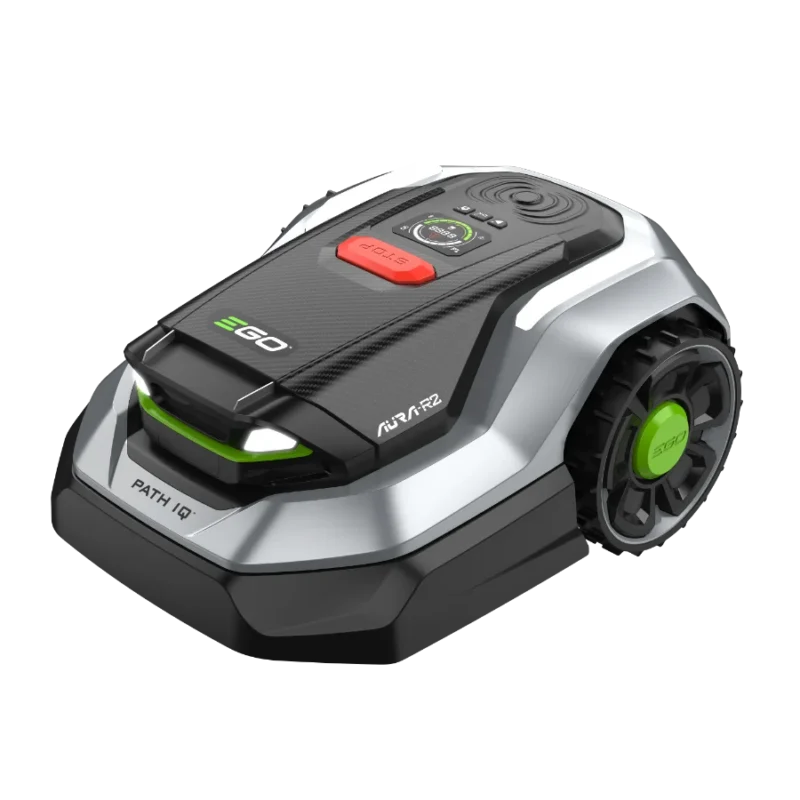
In that case you only have to steer the lawn mower and walk along with it. If mowing the lawn is not exactly a favourite summer activity, today's technology has advanced so far that a robot mower can manage on its own for the whole season and keep the lawn constantly maintained.
A robotic mower is essentially a replacement for a lawn tractor and is designed for areas from a couple of hundred square metres up to 6000 m².
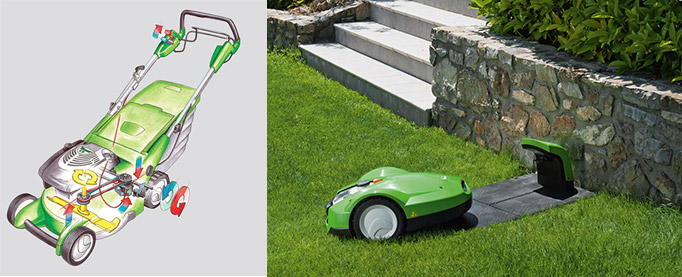
If you do decide on a lawn mower, you should then think about what result you want. If the grass is simply a nuisance to be got rid of, a mower with side discharge or rear discharge is suitable. In that case the stalk is cut and the full-length grass is sent out either evenly spread or in a windrow.
Next you can choose whether to rake the grass together or leave it to dry on the lawn as it is. A downside of side discharge is, firstly, the throwing of the cut grass over a distance, which is not very safe, because along with the grass a stone or other object may also fly off in an unknown direction and cause damage either to windows or to people and pets nearby.
Secondly, with side discharge you have to consider which way to mow so that the flower beds and paths stay clear of grass.
If you decide on a lawn mower with a grass box, raking is avoided and the lawn surface is clean and the cut grass is not carried into living spaces on footwear. Collecting is also very effective when maintaining a mossy lawn, because it lets the lawn breathe and reduces moss formation.
The collected grass can be used to produce valuable compost for use on flower beds. A grass box is also a good added value when clearing leaves in autumn – the leaves can either be shredded first and then collected, or collected straight away in the grass box at the lowest setting.
Mowers with a grass box usually also have a rear-discharge function and a shredding or mulching function. Mowers with a universal blade may not do all these functions perfectly, but there are also mowers that, by changing the blade and fitting a mulching plug, can be turned from a collecting mower into an ideal mulcher.
The mulching function can be used during the driest period of summer, when the grass tends to dry out and turn yellow. In that case the mulch provides the necessary fertiliser and helps to retain moisture better within the grass.
Shredding, or mulching, is a diligent person's pleasure, because the ideal result is achieved when you cut a third of the stalk's length. For example, when mowing 9 cm grass you may take 3 cm and leave 6 cm to grow – only then can the mower shred the grass blades ideally and no clumps of grass form, and by leaving 2/3 to grow the shredded grass also has enough room to disappear into the lawn, leaving an ideal result.
Once you have found a mower with functionality that suits you, you should not overlook its technical construction. The hallmarks of a quality mower are a strong housing, ball-bearing wheels with a rubber coating, a quality blade, the construction of the grass bag, a durable engine and a firmly attached handle.
Housings come in both metal and plastic. There is a common misconception that plastic is weak and breaks easily. This may indeed be the case with cheap lawn mowers, but for example the Viking mowers made in Austria use ABS glass-fibre plastic, which is tested at the factory by “firing” metal balls at it, simulating stones getting into the housing.
Such plastic does not warp or rust, and its service life is considerably longer than that of a mower with a metal housing. Lawn mowers intended for larger areas also use cast aluminium housings, which are extremely strong and durable but require the use of a drive system, because without drive they are considerably heavier to push than mowers with other types of housing.

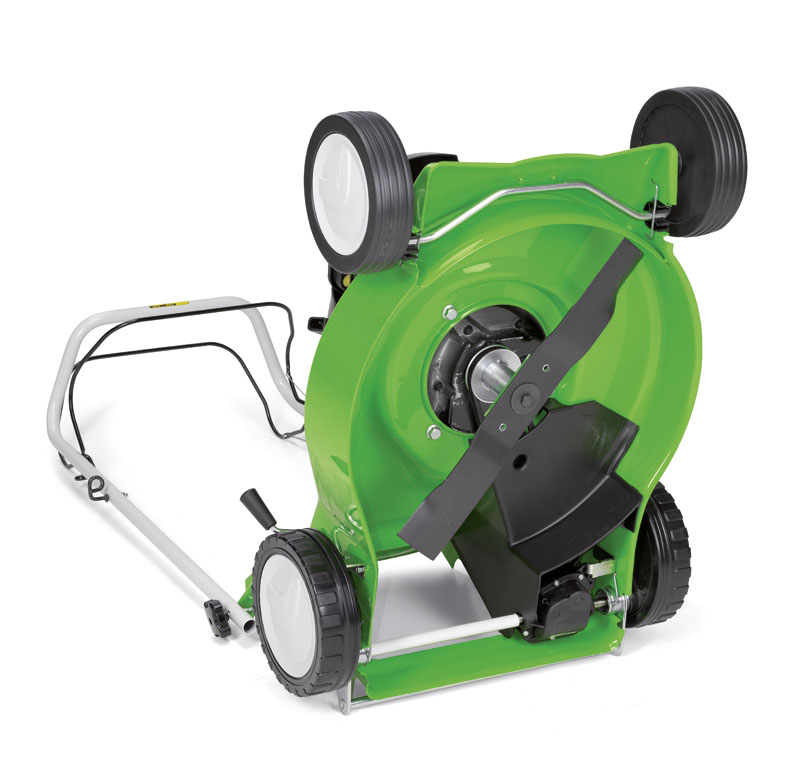
The next important part is the wheels of lawn mowers and how they are attached to the housing. On cheaper lawn mowers there are no ball bearings and the wheel is attached to the sheet-metal housing with a bolt, on which the wheel then rotates.
This solution has several downsides: firstly, such a mower is harder to push; secondly, wheels attached in this way tend to sag out of alignment over time, making straight-line travel difficult; and thirdly, the wheels wear out faster, because there is constant friction between the plastic wheel and the metal wheel bolt.
You can recognise a quality lawn mower firstly by the presence of ball bearings and secondly by the wheels being connected to each other with an axle, which ensures that the wheels stay straight for many years. It is also worth avoiding plastic wheels, because they wear out noticeably faster than rubber-coated wheels.
With driven lawn mowers you should also watch the tread pattern of the driven-axle wheels – with a smooth wheel there is a risk that on damper grass or a slope the wheel starts to spin and does not grip the ground.
The lawn mower blade is something people fail to pay attention to. In reality, the quality of the cut depends, in addition to the shape and construction of the housing, on the quality and bend of the blade. For example, mulching requires either double blades on different planes or blades bent in steps.
For collecting and discharging, the upper outer part of the blade needs to be strongly bent at right angles to the blade – this creates airflow, lifts the grass stalk up and lets the grass box be filled to the maximum, giving the cut grass great momentum.
Many mower manufacturers have tried to achieve all functions with a single blade, but in reality the saying applies: “what is fit for everything is fit for nothing”, and compromises have been made somewhere. In addition to the shape of the blade, the quality of the metal used, its thickness and its resistance to impacts are also important.
Over many years of practice it has happened that a lawn mower blade breaks as a result of an impact and flies through the housing, creating a risk of serious injury.
 The fill level of the grass box depends, in addition to the blade, on the construction of the box itself. With a plastic box it is possible, using aerodynamic solutions, to achieve maximum fill, because there airflows can be directed so that filling of the box starts from the bottom and ends at the top lid.
In addition, a plastic box is closed at the back, which ensures that the grains of sand and other small parts thrown into the box along with the grass are not flung against your legs. With a fabric box, however, the airflows are almost impossible to control, so the grass box is often left half-filled and, in addition, dust and finer particles pass through against your legs.
From a fabric box the cut grass usually has to be shaken out through the same opening through which it is thrown in, whereas on many plastic boxes there is the option of easily tipping the collected grass out by opening the top lid.
With the collecting function it is also important that the cut grass blades travel as short a path as possible into the grass box. The box fills to the maximum and clogging is least likely when the cut grass is thrown straight into the box from the rear part of the housing.
If, however, the collecting tube is routed around from the side of the machine – as with the collecting system of side-discharge mowers – then, with slightly taller or damper grass, clogging is to be expected. Because grass collection and the quality of the cut grass are a rising trend in Western Europe, most modern lawn mowers have a grass box.
 As for the engines of lawn mowers, it is worth preferring manufacturers that also offer spare parts for their products and whose engines are made using quality metal and plastic.
Most mowers in the cheaper price range have engines that are not designed to be repaired: firstly, it is not possible to order spare parts for them, or if it is, the prices are very high and small parts cannot be obtained separately; secondly, the materials used are such that they break easily, making mowing dangerous for the user.
It has happened that the crankshaft of a lawn mower that suffered a sudden impact during work breaks in two and comes off the machine together with the blade. With such engines there is usually no other solution than to fit a new short block or, in the worse case, to replace the engine.
Likewise, on poor-quality mowers the starter system does not hold up – one wrong pull risks deforming the plastic parts of the starter, and you have to fork out several tens of euros for a new starter; in the worse case, a new part simply cannot be ordered as a spare part.
It is worth preferring well-known engine manufacturers with a long history, such as Briggs&Stratton, Kohler, Honda and Kawasaki. With these you can be sure of quality and the availability of spare parts.
 Quality mower manufacturers fit their lawn mowers with engines that are as light as possible but sufficiently powerful to ensure a fine mowing result. The engine power must be balanced with the width of the mowing housing – the wider the housing, the more powerful the engine.
If a small engine has been fitted to a lawn mower with a cutting width of over half a metre, you can be sure that at full width or with taller grass there will be a lack of power.
With a smaller cutting width, a large and powerful engine that has been fitted makes pushing harder and therefore the work more tiring
The worst is the combination when, in addition to a heavy engine, the transmission angle of the handle is such that with every tilt a large load falls on the handle and tension arises between the handle bar and its attachment point.
Lawn mowers with such a technical solution have a high probability of developing play and breaking away from their attachments. The quality of the handle attachment can be tested in the shop by pressing the mower down by the handle bar: if the front end of the mower rises easily, without delay, as a result of the press, then it is a technically sound solution.
 You would be well advised to give a wide berth to mowers that already have play in the handle when new. On many plastic-housing mowers the lower part of the handle bar is integrated into the housing, and on some metal-housing mowers it is attached to the housing at several points, and therefore these solutions are also free of play.
A compact and easily manoeuvrable mower ensures more comfortable and easier handling when mowing.
When choosing a lawn mower, in addition to the purchase price you should bear in mind that it is an investment made for many years, and you should choose a model that is durable, of high quality and for which the availability of spare parts and after-sales service is guaranteed.
The safest thing is to ask for advice from a specialist shop dealing in forestry and garden equipment, where the functionality and construction of different models is explained and you are helped to find a suitable mower, taking into account the particular features of your lawn and plot.