How to choose a chainsaw?

The right choice, or how to choose the right chainsaw

Depending on whether you need to cut firewood, carry out tree care or do something more creative, it often turns out that you need a suitable chainsaw for the job.
But how do you find your way through this jungle of product choices? Do you always need power? Which technical specifications are right for you? Hobby gardeners and home DIYers should look through the product range and take the opportunity to consult a specialist before purchasing.
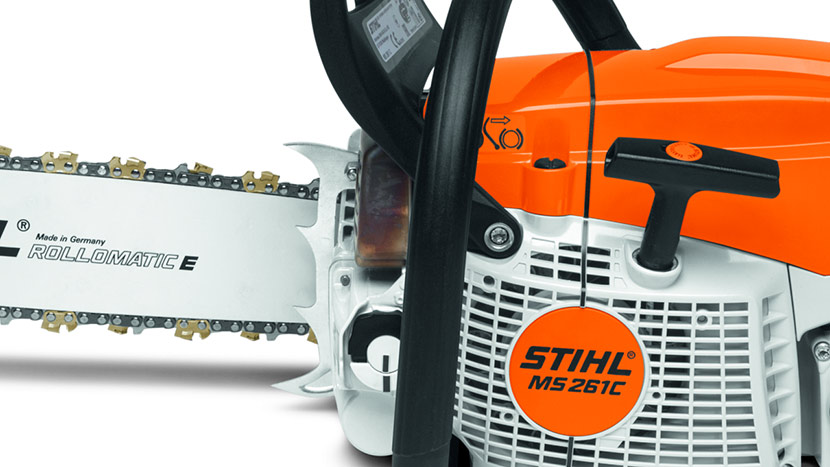
A chainsaw consists of three main parts: the engine, the guide bar and the saw chain. These three parts must be put together so that they match each other and suit the nature of the work.
Because STIHL produces all three of these important chainsaw components itself, we can also guarantee the perfect compatibility of these parts.
Engine: type and power

When choosing an engine, you must first consider the nature of the work to be done. First, think about where the work will be done. If the saw is used near a power socket, an electric motor has its advantages. If you plan to work in the forest, a petrol engine offers sufficient flexibility for this.
For larger gardens, the ideal solution is a battery-powered saw, combining the freedom of movement of a petrol engine with the quietness and environmental friendliness of an electric saw.
The need for performance also depends largely on the nature of the work. Felling trees and making firewood requires considerably more power than cutting branches and pruning trees. There is an age-old debate about whether you should look at cubic capacity or kilowatts when buying a saw – cubic capacity “consumes” fuel and the kilowatt “does the work”.
In other words, the kilowatt provides more power at full revs. The wisest thing when buying a saw is to look at the power-to-weight ratio (kW/kg). For example, the STIHL MS 261 M-Tronic saw has a power-to-weight ratio of 0.61, i.e. 0.61 kilowatts per kilogram. The higher this ratio, the better for the worker.
STIHL offers a wide range of tools for different jobs. If you want to use the saw for multiple purposes, you should choose a saw that can do everything. In that case, consulting a specialist becomes indispensable.
Guide bar: longer is not always better

Although a long guide bar looks impressive on the saw, it is often not only unnecessary but also hinders the work. The longer the guide bar, the more energy it needs to move the chain along the bar.
This affects the saw engine's running speed and performance: in short, you should choose the guide bar according to the cutting-depth requirement and even more according to the engine's power. For most jobs around the home a 30 cm guide bar is sufficient, both for making firewood and for tree care.
A guide bar intended for wood carving is also usually 30 cm long, but its shape differs from a standard guide bar.
STIHL produces a full range of guide bars for all STIHL chainsaws. With a few exceptions, all STIHL guide bars use the oil-saving Ematic system. Every guide bar marked with the letter E is an Ematic guide bar.
Saw chain: robust, precise, low-vibration
The key to efficient cutting is choosing the right chain. The cutting equipment consists of the saw chain and the guide bar. For those who use the saw for jobs around the home, the best choice is a chain with a low vibration level and weak kickback. These properties ensure safety and make the saw comfortable to use.
For working in the forest, a carbide-tipped chain is the best choice. A carbide-tipped chain stays sharp for longer, even when it is used to cut wood that is partly covered in soil, or if it occasionally touches the ground.
If precision is what you are looking for – for example, you want to make precise cuts or do wood carving – the best choice is a full-chisel chain. It differs from other chains in that the chain's cutter has a square edge instead of a rounded edge.
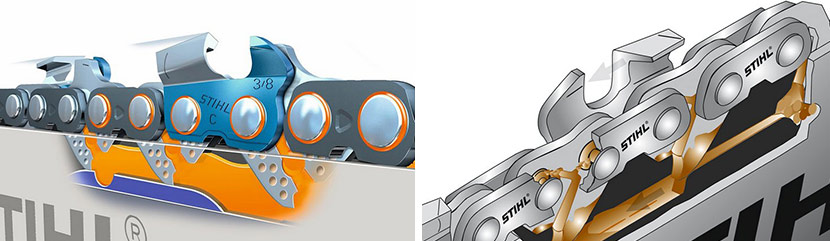
STIHL offers saw chains for all wood types and all makes of chainsaw, regardless of engine size. The saw chain range includes a chain for almost every task. All STIHL saw chains are patented and feature the STIHL Oilomatic lubrication system, which extends chain life. Every saw chain produced by STIHL is an Oilomatic chain.
Proper protective equipment is the key
Working with a saw requires appropriate protective equipment. Protective trousers, forestry jackets, chainsaw boots, chainsaw gloves and other safety equipment in various sizes and shapes are available from STIHL dealers. Proper saw gloves ensure comfort and ease of handling when working with a saw. You can also find a wide range of STIHL head and hearing protection at your nearest STIHL dealer.
The petrol-engine chainsaws in the STIHL range, divided according to the nature of the work
Saws for making firewood and home maintenance work
MS 150/170/180/181/211
Saws for landscape maintenance and smaller forestry work
MS 231/251
Saws for agricultural and horticultural work
MS 291/391
Saws for forestry work
MS 201/241/261/362/661
Arborist saws
MS 150T/193T/201T
Carving saws
MS 150/201
STIHL saw type designations
C – Comfort, i.e. comfort equipment. The letters that follow the C indicate different technical solutions
B – Quick chain tensioning
E – ErgoStart easy-start starter
M – M-Tronic electronic carburettor
V – Electric carburettor heating
W – Electric handle heating
T – top handle