
How to service petrol-engine equipment correctly?

We are often asked how often the air filter or spark plug should be changed, how often the equipment should be serviced and what fuel to use so that the warranty remains valid and the maximum possible running time is ensured. STIHL has developed servicing instructions which, if followed, protect the power tool from excessive wear and damage. The general rule is to use, service and store the equipment carefully, as described in the instruction manual. Below we describe the most important general information on using and servicing two-stroke 2-MIX and also 4-MIX equipment.
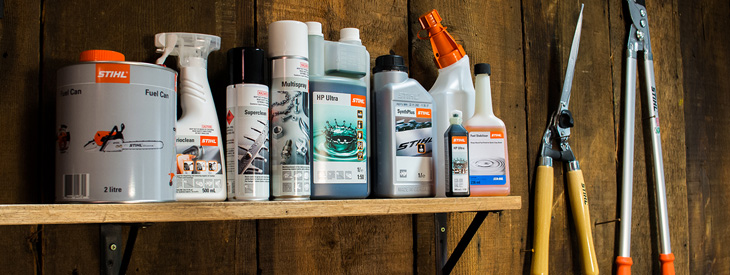
Using the correct fuel mix – how much oil to add and how to store and keep the fuel?
To start the engine, prepare a fuel mix consisting of petrol and engine oil. Use only high-quality two-stroke engine oil. Only high-quality lubricants and engine oils ensure the optimal operation and service life of the equipment. All STIHL power tools use a fuel mix in a ratio of 1:50. The table below makes it easier to choose the right amount of oil:
| Amount of fuel | Amount of two-stroke oil |
| 1 L | 20ml |
| 3L | 60ml |
| 5L | 100ml |
| 200L | 4L |
Mix the fuel – When preparing new fuel, pour the two-stroke oil into the canister first and only then the fuel, then close the canister properly and shake it vigorously, so that the oil and fuel are mixed as thoroughly as possible. The canister should also be shaken vigorously after the canister has stood for a longer time, because STIHL two-stroke oils drive out foreign substances from the fuel (for example moisture and water), which settle into layers in the canister.
Clean the fuel-tank cap before refuelling – Tankimisel clean the fuel-tank cap and also the canister's filler opening/spout. When removing the fuel-tank cap, always position the machine so that the cap faces upwards. Remove the fuel-tank cap slowly so that any excess pressure that has built up in the tank is released gently. With quick-release caps, always leave room the size of the lower part of the cap when refuelling, so that the cap fits into the tank in addition to the fuel. Otherwise the cap cannot be fastened correctly and there is a risk of the cap breaking as a result of using excessive force.
Storing the fuel mix – The best of all options is to prepare exactly the amount of fuel mix needed for a particular job. In practice, however, this is not always possible. So mixed fuel should be stored in a dry, cool and shaded place. As a rule, it is not recommended to use fuel mix that has stood for more than three months, but when using STIHL HP Super or Ultra two-stroke oil, whose additives also extend the fuel's shelf life, such fuel mixes can, under favourable conditions, be stored for up to a year.

STIHL two-stroke oils
|
|
Lubrication features |
Cleanliness |
Resistance to oil-sludge formation |
Corrosion resistance |
Special properties |
Type |
|
HP |
+ |
+ |
+ |
+ |
Good lubrication and combustion properties |
Mineral |
|
HP Super |
++ |
++ |
++ |
++ |
Low-smoke, mixes very well |
Semi-synthetic |
|
HP Ultra |
+++ |
+++ |
+++ |
+++ |
Biodegradable, ash-free combustion |
Fully synthetic |
+ Good ++Very good +++Best
NB! On equipment with a STIHL 4MIX engine – such as the FS90/91/130/131 brushcutters and the BR600 blower – only fully synthetic two-stroke oil may be used. Use only STIHL HP Ultra two-stroke oil. In STIHL 4-MIX engines it is not permitted to use LS (LowSmoke) technology
engine oils.
If the equipment is left standing for longer than 90 days, the fuel tank and carburettor must be emptied of fuel (start it and let it run at idle until the engine stops).
All wear parts must always be replaced in good time so that the warranty remains valid and the normal operation of the equipment is ensured.
Some parts of a power tool experience normal wear even with proper use and must be replaced in good time according to how and how long they are used. These include, among others:
– Cutting tools (of all kinds)
– Cutting-tool mounting parts (thrust plate, nut, etc.)
– Cutting-tool guards
– Clutch
– Filters (air, fuel filter)
– Starter and its parts
– Throttle cable (incl. joints)
– Spark plug
– Anti-vibration elements and housing parts

How often should routine servicing be carried out?
STIHL recommends having servicing and repair work carried out only at a STIHL dealership. To prevent malfunctions and to ensure safe operation and optimal service life, STIHL recommends that a buyer operating in commercial and professional activity (a legal entity) every 300h or every three months, and a private individual (a consumer) every 100h or once a year submit the equipment for routine servicing and inspection to an authorised STIHL service workshop.
Users may carry out only those repair and servicing tasks that are described in the product's instruction manual. More extensive repairs may be carried out only at an authorised STIHL dealership. The data given in the instruction manual assumes normal operating conditions. Under demanding conditions (heavy dust, etc.) and with longer daily operating times, the stated intervals must be shortened accordingly.

So how often should the filters and spark plug actually be changed?
– Air filter – replace with a new one every: paper filter 100h, fleece/felt 100h, HD2 200h, or once a year
– Spark plug – replace with a new one every 100h or once a year (only a STIHL ZAT3 or ZAT4 spark tester may be used to test the spark plug). Testing the spark in any other way can damage the ignition module.
– Fuel filter – replace with a new one every 100h or once a year
What should not be done?
The user of the equipment is responsible for all damage arising from failure to comply with the safety, servicing and maintenance instructions. This applies in particular to the following:
– modifications not authorised by STIHL have been made to the product
– the use of tools and accessories that are not permitted for use with this equipment, that are not suitable for it or are of poor quality
– using the equipment for a purpose other than intended
– consequential damage resulting from continued use of equipment with defective assembly parts
During repairs, use only spare parts that STIHL permits for use on this equipment. Use only high-quality original spare parts. Otherwise there is a risk of causing an accident or damaging the equipment.
Source: STIHL 2-MIX and 4-MIX operating instructions. Supplemented and edited by Liina Liivat.