Robot mowers and thunderstorms — how to act correctly during lightning?
In many Estonian gardens, the robot mower has become a matter-of-course helper. It works quietly and independently, and most of the time you forget it exists altogether — until the first proper summer thunderstorm arrives. That is exactly when, in a few seconds, damage can occur that the owner may not expect: burnt-out electronics.
In Estonia, the thunderstorm season falls mainly on the warm summer months, when mowing is most active and the mower works practically every day. The machine is therefore in its most active use exactly when the risk of a lightning strike is greatest. The good news is that a couple of minutes of preparation before the storm prevents the vast majority of damage. In this article we look at whether a thunderstorm actually damages a robot mower, how a lightning strike reaches the machine and what you can do to keep the mower intact. At the end we talk about warranty and insurance.
Can a thunderstorm damage a robot mower?
STIHL notes that the mower, docking station and power supply may be used in rainy weather, but they are not protected against the electrical effects of thunderstorms or lightning strikes. STIGA emphasises the same principle: according to its instructions, the device should not be used when there is a risk of thunderstorms and lightning, and the docking station should be disconnected from the mains.
Lightning usually does not strike the mower directly. It is much more typical that a nearby strike creates an overvoltage in the mains or in the underground boundary wire, which reaches the machine and destroys the docking station's motherboard, transformer or the mower's control electronics. The docking station electronics are the most common victim, because they are permanently connected to the mains.
How a lightning strike reaches the mower
A lightning strike can reach a robot mower in three ways. First, through the mains: a nearby strike creates an overvoltage in the electricity network, which travels through the plug straight into the docking station's power supply and electronics. Second, through the underground boundary and guide wire. On wired models, a long boundary wire is installed in the lawn, which in the event of a nearby strike can pick up the overvoltage and conduct it to the docking station. This is exactly why STIGA recommends monitoring the weather forecast and disconnecting both the power and the boundary wire before a thunderstorm, if the machine has one. The third path is a direct hit - this is rare but the most destructive, because no protection helps against such force.
Wired and wire-free mowers: what are the differences in lightning protection?
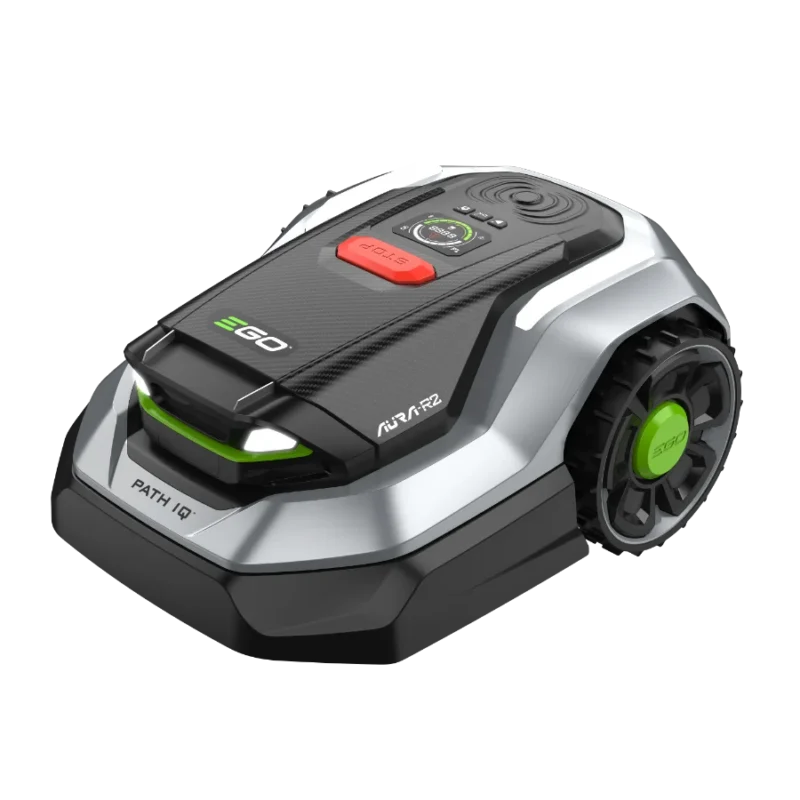
Since one of the main risk paths is the underground wire, a logical question arises: are wire-free mowers better protected against thunderstorms? Partly yes. If there is no wire in the lawn, one path for a lightning strike also disappears. The EGO AURA-R2, for example, is completely wire-free — it uses PATH IQ navigation (RTK satellite positioning together with camera-based mapping), so no underground boundary wire is needed. STIHL iMOW and previous-generation STIGA models, on the other hand, use a boundary wire installed in the lawn.
Wired mower (e.g. STIHL iMOW, STIGA wired models)
- The underground boundary wire can pick up the overvoltage
- The overvoltage can reach the station via both the wire and the mains
- Before a thunderstorm, disconnect the power and the boundary wire too
Wire-free mower (e.g. EGO AURA-R2)
- There is no underground wire — this risk path disappears
- The docking station still remains connected to the mains and is vulnerable
- Before a thunderstorm, it is worth disconnecting from the mains
It is important to understand that a wire-free mower removes one risk but does not eliminate the danger completely. On a wire-free model too, the docking station is permanently connected to the mains and therefore remains a weak point during a thunderstorm. That is why the recommendation to disconnect the device from the mains before a strong storm applies to all mowers.
How to protect a robot mower from thunderstorms
The manufacturers’ advice is simple and clear: if a thunderstorm is expected, disconnect the docking station. Before a strong storm, go through the following steps.
- Unplug the power supply from the socketThis breaks the main path by which the overvoltage reaches the station from the mains.
- Disconnect the power supply from the docking stationThis way the station's electronics are completely isolated from the power circuit.
- Disconnect the boundary and guide wireThis applies to wired models. Mark the cables before removing them, so you can reconnect them correctly later.
- Move the mower under cover if possibleIf possible, move the device into a garage or shed. This way the mower is completely away from the mains.
A rain sensor is not lightning protection
Many mowers, for example the EGO AURA-R2, return home on their own when it rains. This protects the lawn and also the mower’s mechanics, but not the electronics against overvoltage. The mower can be sitting nicely in the station and still burn out, because the station itself is connected to the mains. Automation does not replace physical disconnection.
Surge protection and earthing
Good basic protection is a quality surge protector, which earths part of the overvoltage. This is especially useful when you cannot manually disconnect the station before every storm. Keep in mind, however, that a surge protector reduces the risk but does not give a full guarantee — it does not help against a nearby hit.
A solid foundation for electrical safety is also a correctly carried-out installation. According to EGO’s instructions, the power supply must be installed in a place protected from sun and rain, and the docking station must always be connected to a socket with a residual-current device with a trip current of up to 30 mA. Correct installation does not protect against a direct lightning strike, but it significantly reduces everyday electrical risks.
Five common mistakes that can end badly for a robot mower
Most lightning damage does not happen by accident, but because the thunderstorm seems far away and the device appears to be in a safe place in the station. Here are the five most typical mistakes.
- Relying only on the rain sensorThe rain sensor sends the mower home, but the station stays connected to the mains. Mechanical protection is not electrical protection.
- Leaving the boundary wire connectedOn a wired model, the underground wire is one of the main risk paths. If you disconnect only the power, the other path remains open.
- Assuming that the warranty covers all problemsThe manufacturer's warranty does not cover external electrical effects. A lightning strike is a matter for insurance, not warranty.
- Considering a wire-free mower to be immuneThe risk of damage to a wire-free model is lower, but the docking station also needs protection.
- Incorrect reconnection after the stormIncorrectly reconnecting unmarked cables immediately causes problems on wired robot mowers. Mark the terminals already when disconnecting.
What to do after a thunderstorm
Once the storm has passed, it is not worth reconnecting the device blindly. First reconnect the boundary and guide wire under the correct terminals — this is where the marking you made earlier comes in handy — then the power supply to the station and only finally the plug into the socket. Make sure that the docking station's indicator light comes on normally and that the mower finds the charging point.
If the mower does not start, cannot find the boundary wire signal or the docking station light is off, the part hit by the overvoltage has most likely been damaged. Do not try to force the device to work or open it yourself, as this may void the warranty even on parts that are still intact. It is sensible to have the mower checked by an authorised service partner, who can tell whether it is overvoltage damage and whether it can be repaired. By bringing your robot mower to Saemeister, you can be sure that your mower will be looked after in the best possible way
Document the damage for insurance
If the mower was damaged by a thunderstorm, before any repair take photos of the device and its surroundings and find the proof of purchase. Note down the date and time of the damage. It is easier for the insurance company to pay compensation if the damage can be linked to a specific storm and time — weather service data about the storm is good additional evidence.
Do warranty and insurance cover lightning damage?
This is where you may be in for an unexpected surprise. Lightning strikes and overvoltage are not covered by the manufacturer's warranty, because the warranty covers manufacturing and material defects, not external electrical effects. This is why home insurance becomes important.
According to Estonian insurance companies themselves, a robot mower falls under the home contents protection of home insurance, even though it is kept outdoors. According to PZU, the average compensation for a robot mower claim is close to 1000 euros, and the largest mower claim compensated reached nearly 3400 euros.
An important nuance: overvoltage damage often requires extended home insurance cover
A fire caused by a lightning strike is usually covered, but compensation for electronics damaged by overvoltage often requires broader cover, not the basic package. This is why it is worth reviewing your policy before the storm season arrives.
| Insurer | What their own information says |
|---|---|
| PZU | A robot mower is covered by the home contents protection of home insurance; the average mower claim compensation is close to 1000 €, the largest close to 3400 €. |
| ERGO | Overvoltage and lightning damage to electronics is additional cover: technical systems up to 7, home appliances up to 4 and computers up to 3 years old. Some packages cover only the building's electrical system. |
| Swedbank | Home insurance has compensated for equipment damage caused by the overvoltage of summer thunderstorms; the company recommends disconnecting devices from the mains during a thunderstorm. |
| If | Home insurance with the basic package does not automatically cover a situation where lightning causes a voltage fluctuation and the device breaks down — for full protection you need to choose broader cover. |
Practical recommendation: check on your home insurance policy whether overvoltage damage to electrical devices is covered, and what the age limit and excess for compensation are. If the robot mower is new and valuable, extended cover pays for itself immediately in the event of a single lightning incident.
Sources: STIHL iMOW user manual; STIGA robot mower manual and FAQ; EGO Power+ AURA-R2 product information and installation guide; information published by the insurers PZU, ERGO, Swedbank and If on home insurance and overvoltage damage.